
Company · Environment
Wood, documents, environment
What we can prove: the adhesives, where the timber comes from, the offcuts that go back into production, and the paperwork that reaches the site with the furniture.
In short. We are a small company and no regulation obliges us to do any of what follows. We do it because in the contract business the difference is not made by whoever claims the most: it is made by whoever, on delivery day, also delivers the paperwork.
For every element that reaches the site we send the certificate. Not a generic company attestation: the certificate of that element, of that piece, inside a dossier organised by product family, with labels, photographs and references that follow the project schedule. It is the reason a project manager, working with us, opens without making phone calls.
Formaldehyde and adhesives
We use formaldehyde free timber and formaldehyde free adhesives.
It is worth explaining why that sentence is about the adhesives. In timber, formaldehyde is not in the fibre: it is in the adhesives and binders of the panels. Anyone claiming zero emission timber while saying nothing about the glue is talking about the part that does not emit.
Since 6 August 2026 the European regulation has set the emission limit at 0.062 mg/m³ for furniture and wood-based articles, measured in a test chamber, and places the burden of proof on the manufacturer, not on the panel supplier. We hold that evidence and we hand it over.
Two points few people mention and that matter on our technical desk. The limit applies to the whole product, not to the single material: on a composite piece the verification has to be set up on the piece as delivered. And facing on both sides is not in itself a guarantee, because the edge and any raw face remain open. We take that into account at design stage, not at inspection stage.
For supplies destined to the United States, the CARB2 certification of the panels is issued to us by our timber supplier, and we pass it on to the client together with the rest of the dossier.
Traced timber
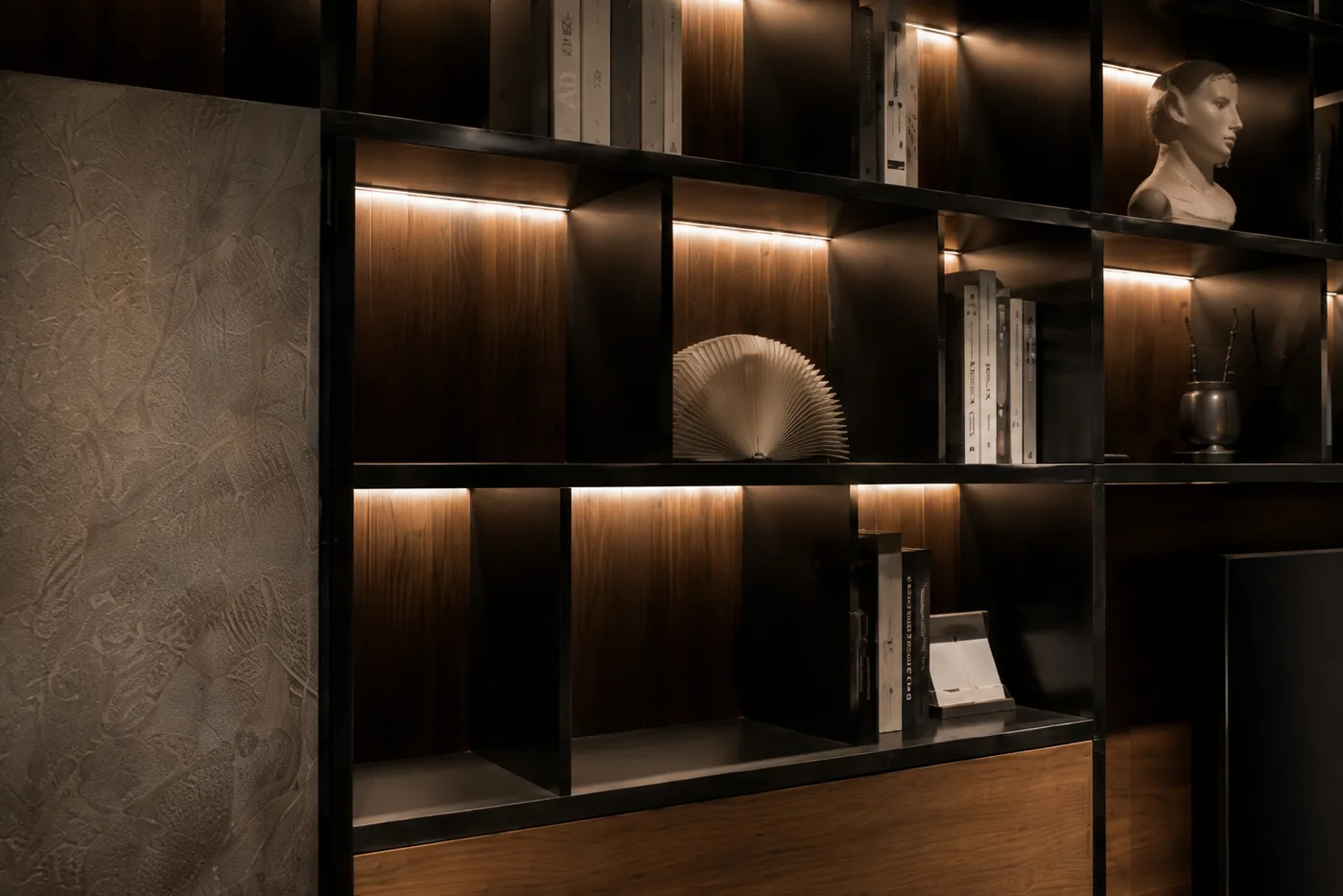
We buy traced, formaldehyde free timber only, and the certificate travels with the product. It is not a choice we make job by job: it is our purchasing rule, and it applies to everything that comes into the factory.
We buy it directly, by the container, on the basis of the projects, raw or semi-finished depending on the supplier. Finishing is always carried out in our own workshops, in Italy. The species are American walnut and burl in veneer, plus solid timber and melamine panels.
Buying directly serves us twice. On price, because between us and the producer there is nobody. And on this page, because on a short chain the origin can be reconstructed, while on a long chain it gets lost along the way.
From 30 December 2026: the European deforestation rule
From 30 December 2026, anyone placing timber on the Union market must demonstrate that the material does not come from land deforested after 31 December 2020 and that it was produced legally, with the geolocation of the plots of origin and a declaration submitted to the European system.
The information the regulation calls for is requested from the suppliers who provide our timber, and that is why we are able to produce it: on a chain with few steps the origin data travels back as far as the plot, while on a long chain it stops at the first intermediary.
Offcuts: we reuse almost all the timber
We produce to measure and we reuse almost all the timber that comes in. Processing offcuts go back into production as reworked material: they become smaller elements, internal components, pieces that bespoke furniture always needs.
It is a consequence of the way we work rather than an environmental claim made after the fact. Series production cuts to fixed sizes and what is left over is unusable. Bespoke production, like ours, always has a smaller piece to take out: the board that yields the side panel of a wardrobe also yields the rail, the shelf and the batten.
Furniture that lasts
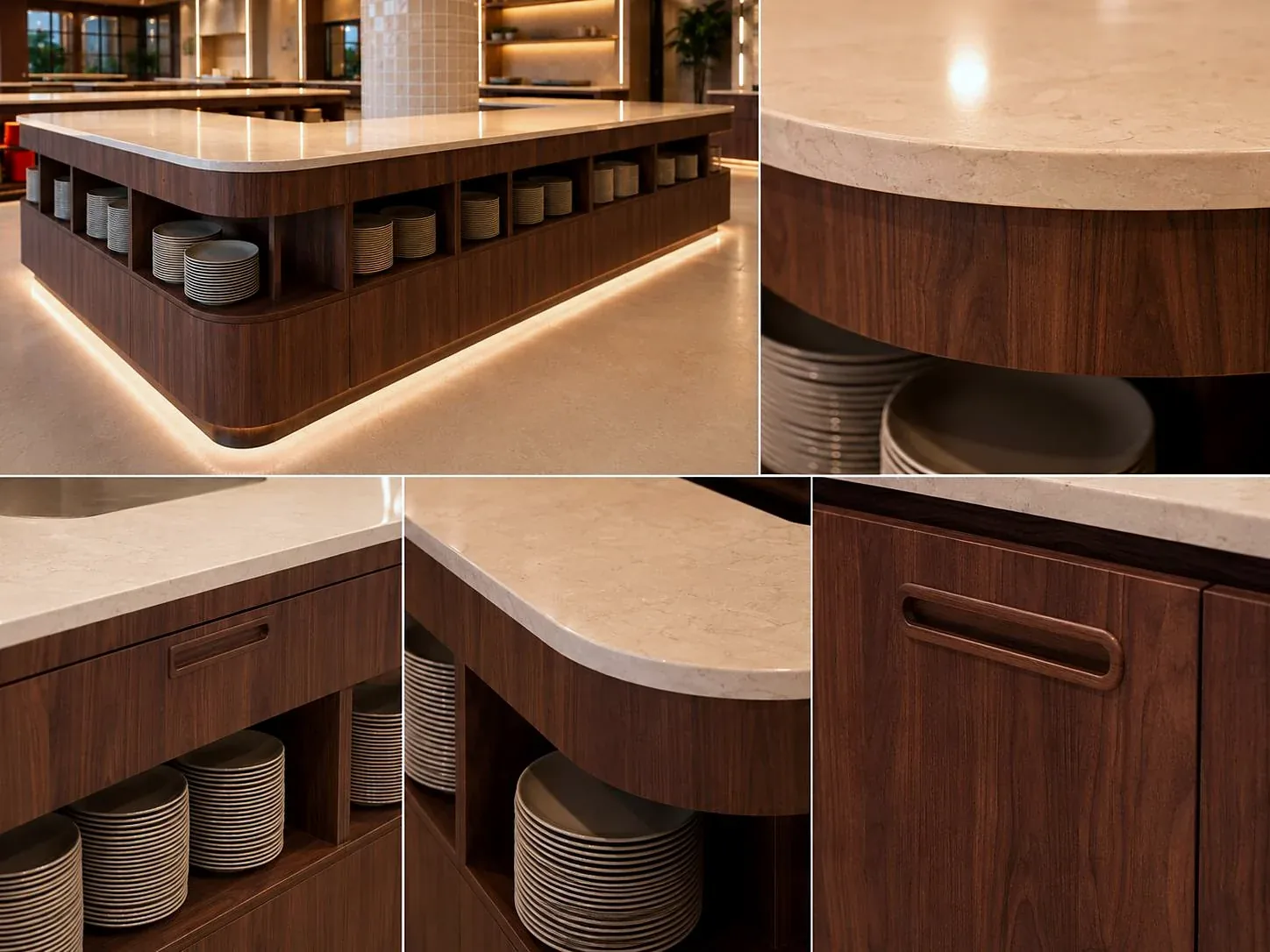
Furniture that lasts is the first saving of material, and no certificate replaces it. Our pieces are made to measure, with first choice materials and a twenty-four month warranty that becomes seven years on resin components. On composites, second choice material yellows and stains within two or three years, irreversibly: we do not offer it, and we always advise the client to ask their supplier for the composition and the warranty.
Furniture replaced after three years is paid for twice: once on the invoice and once in material.
Where we stand on certification, plainly
We have filed our application for PEFC certification and we are waiting for the certificate.
Until that day we do not display the mark. Forest certification marks belong to those who have passed the chain of custody audit, and a logo placed before the certificate is not an anticipation: it is a statement that the first documentary check takes apart. We would rather get there with the certificate number in hand and write it here.
In the meantime, what we deliver is the list below, and we have always delivered it.
The dossier that comes with the supply
- fire certification of upholstered items under article 10 of the Italian Ministerial Decree of 26 June 1984, with testing carried out on the final product where class 1 IM is required;
- certificates of the individual elements, for every element supplied;
- formaldehyde emission documentation for the panels used, and CARB2 certification where the supply is destined to the United States;
- timber origin documentation requested from suppliers for the purposes of the European deforestation regulation;
- labels, photographs and references for every piece following the project schedule, organised by product family;
- twenty-four month warranty, seven years on resin components.
Talk to us The contract division
The regulatory references quoted are current at the date of publication of this page. Fire safety design and conformity checks remain the responsibility of the appointed professional.