

Creative Director
Silvia Gibertoni
Brianform: living as an expression of yourself. A home should not tell of a trend. It should tell of the person who lives in it.
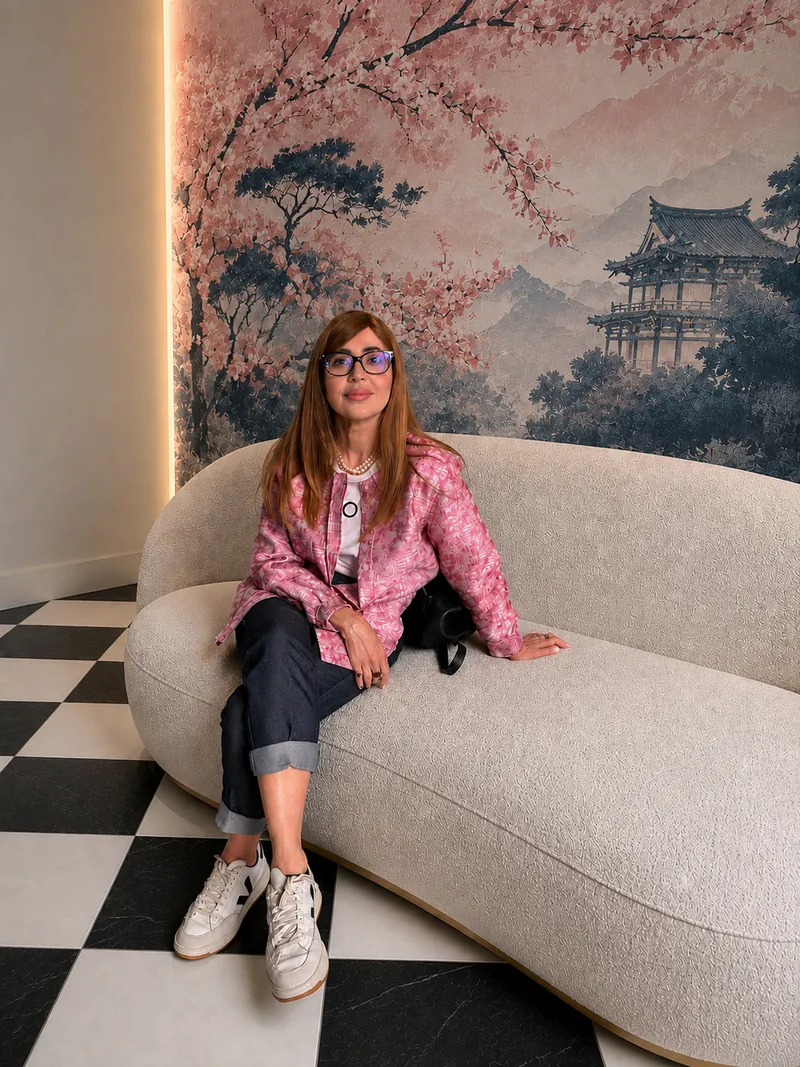
The path
Art, dance and culture before design
The path of the Creative Director of Stoneform and Brianform begins far from the traditional boundaries of design. Before arriving in this world, Silvia Gibertoni worked in cultural institutions, in the performing arts and in opera and symphony foundations, while all along cultivating the study of art and an interest in it — which shaped her eye and her sense of beauty.
Woven into that path are fourteen years of classical ballet, a discipline that trained her eye in rigour, harmony, proportion and the relationship between body and space.
Art, dance and the different experiences gathered in the world of culture make up an unconventional path, built more through crossovers and varied interests than through a single training — and it is from there that her personal way of interpreting the role of Creative Director comes today.
A new chapter
Brianform was founded in 1982, in the heart of Brianza, in a territory where furniture is not only an industry but a culture, a body of skill and craft knowledge handed down over time.
Today Silvia Gibertoni is guiding the company through a new chapter of its history: not a break with the past, but an evolution from the solidity of an important tradition towards a freer, more contemporary language, closer to fashion, to art and to new ways of living.
The interview
Brianform was founded in 1982 with a more classical identity. How do you work on a company with more than forty years of history without losing that identity?
By starting from respect.
I do not believe in transformations that need to erase what came before in order to assert something new. Brianform has more than forty years of history, a culture of furniture, a knowledge of the processes and a seriousness in production that amount to a real heritage.
But having a history does not mean having to stand still.
That is exactly the passage that interests me: keeping the skill and changing the way of looking.
Homes have changed, the way we live has changed, and so have the crossovers between art, fashion and design. It seems natural to me that a company should evolve along with its own time.
Tradition, when it is authentic, should not be afraid of the contemporary.
What does living in a home mean to you?
I believe a home is one of the most intimate forms of self-portrait.
It says a great deal about us, often more than we imagine. It tells of what we chose, what we inherited, the places we have been, the things we are attached to and even our contradictions.
That is why I am not especially fond of homes that look like showrooms, where everything is perfectly coordinated and each thing seems to have been chosen at the same moment.
Perfection, at times, risks erasing identity.
I am far more moved by a home in which a contemporary piece can live alongside an object found on a journey, a work of art, something that belonged to the family, or simply something chosen because it moved us.
A home should have memory, but also desire.
The relationship between interior design and fashion returns often in your work. What do these two worlds have in common?
A great deal.
Fashion has an extraordinary ability to read its own time. It does not speak only of clothes: it speaks of colours, proportions, materials, behaviour and social change.
And then there is something I find particularly interesting: the way we dress and the way we live are both forms of representing ourselves.
A garment enters into a relationship with the body; an interior enters into a relationship with our life.
In fashion, a silk can meet a leather, a precious fabric can be worn with something extremely simple, and an apparently wrong colour can turn out to be exactly what makes an outfit memorable.
Why should we have less freedom in furniture?
I am not interested in transferring fashion trends into furniture. I am interested in bringing that same freedom of interpretation into the interior.
So imperfection can have a value of its own?
I prefer to call it the unexpected element.
I do not believe elegance necessarily comes from the perfect match. Sometimes it is precisely something that does not entirely belong to the whole that gives it personality.
It is true in fashion and it is true in furniture.
A room in which everything is of the same style, the same period and perfectly coordinated can be beautiful, but it risks being predictable.
I always look for a small element of rupture: a material, a colour, a proportion, an object.
It must not disturb. It must create a tension.
Beauty, for me, is not necessarily absolute balance. Sometimes it is born precisely from the dialogue between different things.
How much do materials count in building this identity?
Enormously, because materials are not only something we see: they are something we touch.
Wood has a warmth, leather changes over time, a fabric absorbs light differently, metal introduces a reflection, glass creates lightness. This tactile dimension of furniture interests me a great deal.
We live in an extremely visual age, in which we are used to discovering and often choosing a product through a screen. Rendering is an extraordinary tool for imagining what does not yet exist, but an image, however perfect, will never fully convey the experience of the material, the proportions and the comfort.
A home, after all, is not lived through a screen. It is lived with the whole body: we sit down, we touch, we walk, we feel a surface under our hands.
That is also why it matters to us to have our showroom in the heart of Brianza, in Cantù. It is the place where what is imagined and designed becomes real: you can see a piece in its true proportions, touch its materials, sense its finishes, sit on a sofa and truly understand its comfort.
A piece of furniture must be beautiful to look at, of course, but it must also make you want to touch it. And I believe design, before being an image, should be an experience.
And colour?
Colour is emotion.
It can completely change the way an object or a space is perceived. And yet in furniture we are often more afraid of it than we are in fashion.
We are far more willing to wear a colour, even a bold one, than to bring it into the home.
I believe instead that colour, used intelligently, can give a room an extraordinary identity.
That does not necessarily mean filling a home with colours. One precise point can be enough: a leather, a fabric, a detail.
I like to think of colour not as decoration, but as part of the design.
Brianform also works on customisation. How important is compositional freedom?
It is fundamental, because if I start from the idea that a home should tell of the person who lives in it, I cannot then impose the same home on everyone.
For me the product must be a proposal, not a cage.
You can start from a sofa, a bookcase or a table and then work on the dimensions, the woods, the leathers, the fabrics, the metals and the finishes, so that the piece truly finds its own place in a space and in the life of whoever chooses it.
It is an idea that interests me greatly: not asking the person to adapt to the furniture, but allowing the furniture to enter their story.
This compositional freedom is one of the finest possibilities craftsmanship offers us.
Is there still room for emotion in a sector increasingly dominated by image and communication?
There has to be.
An object can be technically perfect, magnificently photographed and communicated extremely well. But if it provokes nothing, within seconds we have already forgotten it.
What interests me is that moment when we look at something and, before we even know why, we stop.
It can be a curve, a material, a detail, an unusual pairing. There is no formula.
But I believe design needs this too: not only solving a function, but creating a relationship.
In the end we live for years with the objects we choose for our home. It is natural to want them to be able to keep saying something to us.
What, then, is the Brianform you imagine for the future?
A Brianform that is recognisable, but never predictable.
A company able to keep the seriousness, the artisanal knowledge and the manufacturing culture it was born with in 1982 and, at the same time, free enough to experiment.
I would like it to speak more and more with fashion, with art, with colour and with new languages, without turning into something that endlessly chases trends.
I am not interested in Brianform simply becoming more modern. I would like it to become ever more contemporary.
For me there is an important difference.
Being modern can mean adhering to an aesthetic. Being contemporary means being able to read your own time without losing your identity.
And perhaps this is exactly the home I am interested in imagining through Brianform: a home that is not afraid to mix periods, materials, memories and desires. A home built not to be photographed, but to be lived in.
«The most authentic elegance is exactly this: feeling represented by the place where you live.» Silvia Gibertoni — Creative Director